
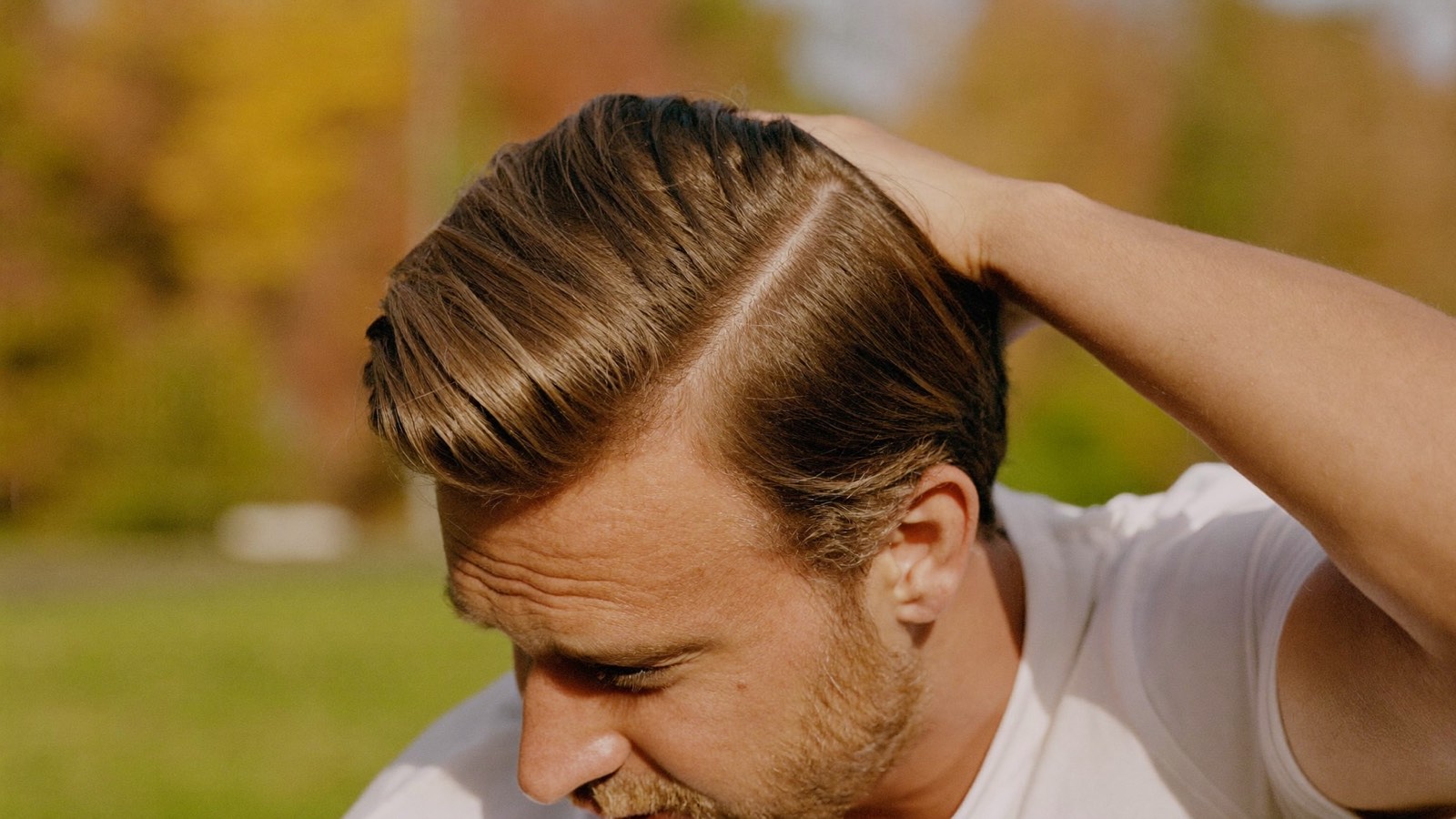
Temple point restoration rebuilds the two small, forward-pointing triangles of hair at the sides of the head, above each temple and in front of the ears, where the sideburn rises to meet the side hair. Most people never think about them until they thin, and then the face can look oddly unframed even when the rest of the hair is in decent shape. At our Middleton clinic the work is done with FUE hair transplant grafts, taken one at a time from the back of the scalp and set at a very flat, carefully steered angle. This guide explains what the temple points are, why they change how a face reads, who tends to be a good candidate, how the points are designed, how healing and growth unfold, and what goes wrong when the design is rushed.
Temple points are a finishing detail rather than a large coverage job. That means the planning matters far more than the graft count, and it is the reason this area is worth understanding before you sit down for an assessment.
Where the Temple Points Sit on the Head
People use the word "temples" for two separate things, and the difference shapes the whole plan. Temple recession is loss at the corners of the hairline, the two bays that deepen above the outer ends of the eyebrows and slowly turn a straight front into an M shape. Temple points sit lower and further back. They are the little triangles of side hair that grow up from the sideburns and point toward the outer corner of each eye. Turn side-on to a mirror and they are the hair that fills the space between your eye and your ear.
The two areas can thin together or on their own. Plenty of men keep full temple points for years while the corners recede, and the intact points then make the recession look deeper by contrast. Others notice the points wearing away first, usually from the tip backward, so the triangle shortens and the sideburn seems to stop abruptly. A smaller group, women included, lose the points to tight hairstyles that pull at the sides, or to scarring after cosmetic surgery close to the hairline.
Because the points sit on the side of the head, they are judged from a different viewpoint than the hairline. A hairline is mostly seen face-on. Temple points are seen in profile, in photos taken at a three-quarter angle and by anyone sitting beside you at a table or in a car. That changes how they are designed, as the sections below explain.
Why Temple Points Change How a Face Looks
The temple points do a quiet but real job. They mark the outer border of the upper face and connect the hairline above to the sideburns and beard below. When they are present, the eye reads one continuous frame running from the forehead to the jaw. When they are missing, that frame breaks, and the forehead can look wider and the face longer even if the hairline itself has hardly moved.
- From the front: full points narrow the visible forehead at the sides and keep the face from looking stretched upward.
- In profile: the triangle fills the gap between the outer eye and the ear. Without it, the side of the head can look bare, above all with short cuts.
- With a beard: for men who keep facial hair, the points carry the line of the sideburn up into the scalp hair, so beard and hair look like they belong together.
- With glasses and tapered cuts: the arm of a pair of glasses runs right across this area, and a short taper around the ears leaves it exposed, so thinning here tends to be more noticeable than people expect.
Rebuilding the points rarely changes how much hair someone seems to have overall. What it changes is proportion. The effect is usually closer to a more finished, balanced look around the eyes than to added fullness, which is a useful way to set expectations before deciding whether the work is right for you.
Who Is a Good Candidate for Temple Point Restoration
Temple work suits people whose loss at the sides has settled into a predictable pattern and who have healthy donor hair to spare. In general, the doctor looks for:
- Loss that is stable or changing slowly. If the points are still retreating quickly, new grafts can end up stranded as native hair keeps moving back around them. Medical treatment first, or simply some time to see how the pattern settles, can make the plan hold up better.
- A donor area with fine hairs. Temple points need relatively few grafts, but they need delicate ones. These usually come from the lower back and sides of the donor zone, and there has to be enough of them.
- Hair that blends. Fine, straight, dark hair against pale skin is the hardest combination to match at the temples. Wavy or curly hair, or hair close in shade to the skin, tends to hide small irregularities more easily.
- Clear expectations. The aim is a natural frame that suits your age, not the sharp, low points of a teenager.
Some people are better served by waiting or by a different approach. A man in his early twenties with fast-moving loss may be advised to hold off. Diffuse thinning across the whole scalp, patchy loss that could suggest alopecia areata, and thinning linked to a health problem all need a diagnosis before surgery is discussed. Women with traction loss at the temples can be good candidates once the style causing the pull has changed, because grafts placed into skin that is still under tension can be lost the same way. Scarring from an earlier procedure near the temple is assessed on its own terms, since scar tissue has a different blood supply from normal scalp skin.
How Temple Points Are Designed
Designing temple points is closer to drawing than to filling an area. Dr. Richard Parfitt, MD reviews the design with every patient at the planning stage, and the main decisions are made before a single graft is taken. Five details carry most of the weight:
- Where the tip sits. The apex of each triangle is set using fixed landmarks such as the outer end of the eyebrow and the top of the ear, so the point frames the eye without crowding the face. Both sides are then checked for balance. Faces are rarely symmetrical, and an exact mirror image can look stamped on.
- Angle. Hair at the temples lies almost flat against the skin. Grafts here go in at a very shallow angle, much flatter than on top of the head, so the new hairs hug the side of the scalp instead of standing out from it.
- Direction. Temple hair does not point straight back. It usually runs down and back toward the ear, and the direction shifts gradually between the sideburn and the hairline corner. Each recipient site follows that change and is lined up with the surviving native hairs nearby.
- Single-hair grafts. The points are built almost entirely from one-hair grafts, the most delicate the donor can supply. Grafts carrying two or three hairs read as dots or tufts at the temple, which is a common giveaway of older or hurried work.
- Matching what is already there. Caliber, shade, wave and the spacing of the remaining hair are all studied so the new hairs sit into the existing pattern. A slightly irregular spacing, with a soft outer edge, is deliberate: natural temple points fade out gradually rather than ending at a hard border.
The table below sums up what each element controls and the tell-tale sign that it was missed.
| Design element | What it controls | Sign it was missed |
| Tip position | How the points frame the eye and forehead | Points that sit too far forward or too low, giving a crowded, helmet-like look |
| Angle | Whether the hairs lie flat to the skin | Hairs that stick out from the side of the head and catch the light |
| Direction | How the points merge with sideburns and side hair | A swirl or seam where new and native hair meet at odds |
| Graft size | How soft the edge looks | Visible dots or small tufts, especially with short or wet hair |
| Hair match | How the new points sit with existing hair | Hair that looks coarser, darker or straighter than its neighbors |
The design is agreed before surgery starts: the temple points are drawn on the skin, photographed from the front and both sides and reviewed with you on the day. If the shape does not feel right, that is the moment to say so, because changing a design after the grafts are in is far harder than adjusting a pen line.
How Many Grafts Temple Points Need
Compared with a hairline or a crown, temple points are a small job. The graft estimator on our cost page uses a starting range of 300 to 600 grafts for the temples zone, both sides together. Treat that as a rough guide rather than a quote. The real number depends on how much of each triangle is missing, how dense the remaining hair is, how fine your donor hairs are and whether the hairline corners are rebuilt in the same session.
Graft count also matters less here than elsewhere. Temple points are judged by how natural they look up close, and squeezing in extra grafts at a steep angle can make the area look worse, not better. For a fuller explanation of how counts are worked out zone by zone, and why your donor supply sets a ceiling over a lifetime, see our guide to how many grafts you need.
Temple Points on Their Own or Together With Hairline Work
Temple points are sometimes treated by themselves, but more often they form part of a frontal plan. The two areas meet at the corner of the hairline, and that junction is where careful and careless work are easiest to tell apart. When both are planned together, the hair direction can turn smoothly from forward-facing at the front to down and back at the sides.
Treating the points alone makes sense when the hairline is still in good shape, when an earlier hairline transplant left the sides untouched, or when the points were lost to traction or a scar. Combining them is usually the better plan when the corners have receded too, because rebuilding one without the other can leave a step or a gap where they should meet. Our comparison of receding hairline and crown transplants explains how a frontal plan is ordered when donor hair is limited.
Timing matters as well. Where the front and the crown are both thinning, the hairline and the temple frame usually come first, since they shape the face the most. The doctor will also keep a donor reserve in mind in case native hair behind the new frame thins later and needs attention.
What Happens on the Day of Temple Work
A temple-only session is usually shorter than a full frontal session, because fewer grafts are involved. The steps match any FUE procedure, with extra care at the planning and placement stages:
- Design and photos. The temple points, and any hairline changes, are marked on the skin, reviewed with you and photographed.
- Local numbing. The donor and treated areas are numbed so you stay awake and comfortable throughout.
- Graft collection. Follicles are extracted one by one with a small punch, and the slimmest single-hair grafts are set aside for the temples.
- Recipient sites. Tiny openings are made at the planned angle and direction, under the direct supervision of the doctor.
- Placement. Grafts are placed into those openings, with the slimmest at the tip of each point and slightly fuller grafts toward the base.
Because the temples sit next to the side hair, many temple cases can be done without shaving the top of the head, though the donor area may still need a small clipped band that longer hair can cover. Our article on the non-shave hair transplant explains who qualifies and what the trade-offs are.
Recovery and Growth at the Temples
Healing at the temples follows the same broad pattern as the rest of the scalp, with a few local quirks worth knowing in advance:
- The first week: small crusts form around each graft. Swelling from the forehead can drift toward the eyes for a few days, more so when the hairline is treated in the same session. Sleeping with your head raised helps.
- Glasses and headwear: the arms of your glasses rest close to the new grafts, so ask the clinic when normal frames are fine and slide them on gently in the meantime. Caps, headbands and headphones that press on the sides should wait until the team says otherwise.
- Weeks 2 to 8: most transplanted hair shafts shed, and the temples can look much as they did before surgery for a while. This is expected, because the follicles stay under the skin.
- Months 3 to 4: fine new hairs start to appear. Temple hair is naturally thin, so early growth here can be hard to spot.
- Months 6 to 12: the points fill in, darken and settle into their planned direction. Most of the result is visible by about twelve months, with texture maturing for up to eighteen.
Shaving and trimming around the sideburns needs care in the early weeks, since a razor or trimmer passing over the base of the points can catch new grafts. Follow your written aftercare sheet for when trimming is allowed. If you have native hair around the points, some temporary shock loss is possible in the first months, and it usually grows back.
Risks of Poor Temple Design
Temple work is unforgiving because the area is seen from the side, in good light, often with short hair. Most problems here are design problems rather than healing problems, and they are hard to undo once the grafts have grown. Signs of a poorly planned result include:
- Points set too low or too far forward. An aggressive shape can look fine at thirty and strange at fifty, especially if the hair around it keeps receding.
- Hairs placed too steeply. Grafts that stand away from the skin make the side of the head look spiky and are hard to style around.
- The wrong direction. Hairs that point straight back or upward clash with the sideburn and side hair and form visible whorls.
- Coarse or multi-hair grafts at the edge. These show up as dots or plugs, most obviously when the hair is wet or cut short.
- Two identical triangles. Exact symmetry looks artificial. Natural points differ a little from side to side.
- Overspending the donor. Using too much of the fine donor hair on the temples can leave less for the hairline later.
The general risks of any hair transplant apply as well, including swelling, temporary numbness, infection and the shock loss mentioned above, though serious complications are uncommon. If earlier temple work elsewhere looks unnatural, repair is sometimes possible by removing or redirecting grafts and softening the edge with single hairs, but it is slower and more limited than getting the design right the first time.
Planning Temple Points at Our Middleton Clinic
At our Middleton clinic, serving Madison and the surrounding area, Dr. Richard Parfitt, MD oversees every temple point plan from the first assessment through the design session and the follow-up visits. The assessment looks at how your temples have changed, how the hair at the sides grows, the quality of your donor area and whether medication or a wait would make sense first. You see the proposed shape from the front and both sides before anything is decided.
Questions worth bringing to the consultation include where the tips of the points would sit, how many grafts the doctor expects to use on each side, whether the hairline corners need work at the same time, and how the plan would look in ten or twenty years. If you have older photos from when your temples were fuller, bring them too. They are a helpful guide to your natural pattern.
Talk to Us About Your Temple Points
Book a free assessment at our Middleton clinic, serving Madison and the surrounding area. We look at your temples from every angle, explain whether they can be restored on their own or with the hairline and give you a graft estimate. Call (414) 888-6426.